
Build better judgement around behaviour change
The question I hear most often is not, “Can we add gamification?”
It is usually something more useful:
“Why are people not doing the thing we hoped they would do?”
That is where good gamification and behavioural design begins.
Not with points, badges, or leaderboards.
With a closer look under the bonnet of motivation, friction, confidence, context, and follow-through.
Our training helps teams build that kind of judgement. The aim is not to hand over a fashionable framework. It is to help your people think more clearly about behaviour, design more responsibly, and create momentum that lasts.
For more than a quarter-century, I have worked with organisations trying to move people from good intentions to meaningful action. Some of that work happens in client projects. Some happens in lecture theatres. Some happens through conversations with researchers, founders, clinicians, designers, and sustainability leaders around the world.
The training brings those worlds together in a practical way.Why this matters
Most organisations can describe the outcome they want.
A healthier patient journey.
A more engaged community.
A stronger sustainability habit.
A product people return to because it genuinely helps them make progress.
The harder question is behavioural:
What has to change in everyday life for that outcome to become real?
That is the gap our training is designed to close.
In Health & Wellbeing, awareness is rarely enough. People need confidence, feedback, autonomy, and support that fits into the messy reality of daily life.
In Sustainability & Local Resilience, ambition only becomes useful when people can participate, see their contribution, and feel part of something worth sustaining.
Gamification strategy, when it is done well, is not decoration. It is a way of shaping the conditions that help people move from friction to momentum.
"One of the best learning experiences of my career." - Deborah Garfen, Product Designer, British Heart Foundation

What your team will learn
1. How to diagnose behavioural friction
Before designing mechanics, we look for the blockage.
Is the problem unclear feedback? Low confidence? Too little autonomy? A weak sense of progress? Competing pressures in the real world?
This diagnostic step matters because the wrong mechanic can make a problem louder without making it better.
2. How motivation really works in practice
We translate behavioural science into plain English.
For example, self-determination theory tells us that people are more likely to stay engaged when they feel a sense of autonomy, competence, and connection. In practice, that means designing experiences where people have meaningful choices, can see themselves improving, and do not feel like they are being manipulated.
That distinction is important.
Good gamification and behavioural design respects people. It does not try to trick them.
3. How to design for sustained momentum
Short bursts of attention are easy to create.
Sustained participation is harder.
We explore how feedback loops, progress structures, social dynamics, narrative, and recognition can support long-term movement without relying on hype or pressure.
The goal is to help your team make better design decisions long after the workshop has ended.
What I bring into the room
Practical client experience
The strongest lessons come from real projects, where behaviour is never as tidy as it looks on a slide.
Work with organisations such as Good Boost, Circlr.io, and Vape Escape has reinforced a simple truth: design choices matter most when they meet people in the constraints of real life.
That is the perspective I bring into the training.
Academic discipline
As a visiting lecturer at King’s College London and ESCP Europe, I teach the behavioural science behind engagement, motivation, and change.
In training, that academic foundation is kept rigorous but accessible. We use theory where it helps teams make better decisions, not to make the room feel clever.
A global field of view
Through Gamification Europe conference and the Health Points podcast, I have spent years learning from practitioners and researchers working across different cultures, sectors, and systems.
That wider view helps teams see what is genuinely useful, what needs adapting, and what is probably best left on the conference stage.
My approach to training is built on facilitated problem-solving. I use clear, narrative-led frameworks to help your team navigate the complexities of behavioural design. My goal is to upskill your people so they don't just follow a manual, but learn to think like behavioural designers themselves.
How the training works
- Strategic workshops
Focused sessions built around a live challenge your team is facing.
We use accessible behavioural frameworks, practical examples, and facilitated problem-solving to move from broad ambition to clearer design choices. - Mentoring and coaching
For teams that want to build capability over time, I can work alongside product leads, founders, innovation teams, or internal champions as a thinking partner.
This often fits naturally with our Fractional CGO work, where the focus is long-term judgement rather than one-off inspiration. - Leadership briefings
Senior teams sometimes need a clear, grounded view of what gamification and behavioural design can — and cannot — do.
These sessions help leaders understand how to use engagement strategy responsibly, especially when the stakes involve healthier people, stronger participation, or more resilient systems.
Who is it for
This training is particularly useful for:
- Health-tech and wellbeing teams designing for sustained behaviour change
- Sustainability-led organisations trying to turn ambition into participation
- Product and innovation teams that want a stronger behavioural foundation for engagement
- Leaders who need to make better strategic decisions around motivation, community, and long-term value
If your team is dealing with a challenge where human behaviour is the hard part, this is usually the right place to start.
Let's have a conversation
If you want to build internal capability around gamification strategy and behavioural design, I would be glad to explore what that training could look like for you.
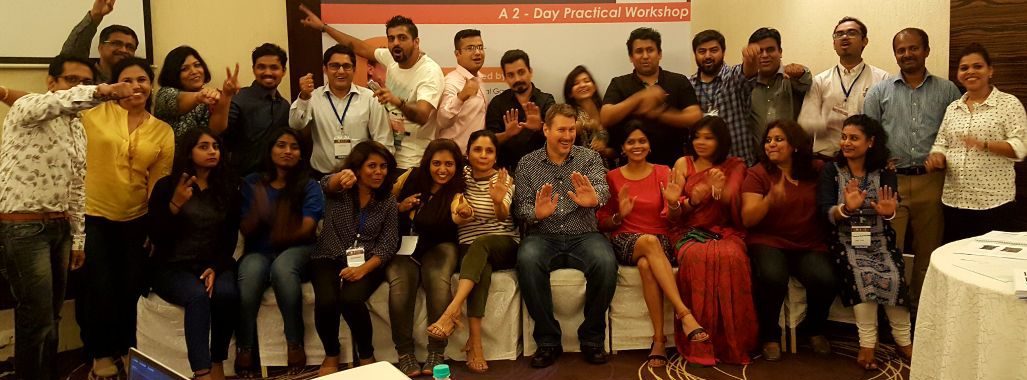
Here is some feedback from attendees of one of our one day in-house trainings on gamification:
Is there anything you learned that you feel you can implement straight away?
- Yes, specific processes can be gamified.
- Inspiration to take action.
- Introducing more games into our process.
- Making my presentation more interactive.
- Making our selection process on an assessment day more fun.
- Several things - mentoring/ making the process more fun.
- I think we can use games straight away.
- Rework our intranet
- Yes, too many ideas to list here!
- Making certain training more fun.
What were the best features of the course?
- Interactive group work
- Good ideas from other companies
- Interactivity and use of videos
- Interactive, games, variety of free online games
- Interactive videos
- Being interactive with everyone in the room
- Being able to play games in a team
- Interaction between teams
- Different theories and game ideas for induction process
- Learning something new. It was a fun day.
- Variety, detailed but keeps moving.
- Simple ideas related to the business world.
- The variety + made aware of how many areas can benefit from gamification
Do you have any other comments?
- Enjoyable, fun day. Thank you.
- Trainer was v. engaging.
- A day well spent.
- The course tutor was very interesting.
- Thanks for your time!
- Great day. Lots of fantastic ideas all very practical.